
What "built-in" and "freestanding" actually mean
A built-in (fitted) wardrobe is made to the measured opening: the carcass is cut to your wall, scribed to the ceiling and side walls, and fixed to the structure. There is no gap to clean behind, no dust ledge on top, and the return panels close the ends. In Hong Kong the carcass is normally 18mm board with a 9mm back panel, and the unit is drawn before it is cut — nothing exists until the drawing is signed.
A freestanding wardrobe is a finished box in a standard size, usually 500mm, 750mm or 1,000mm wide, 580–600mm deep and around 2,010mm high. It arrives assembled or flat-packed, stands on its own, and leaves with you when you move. The trade-off is geometric: standard sizes never match a Hong Kong alcove, and the 590mm between the top of the unit and a 2,600mm ceiling is storage you paid rent for and cannot use.
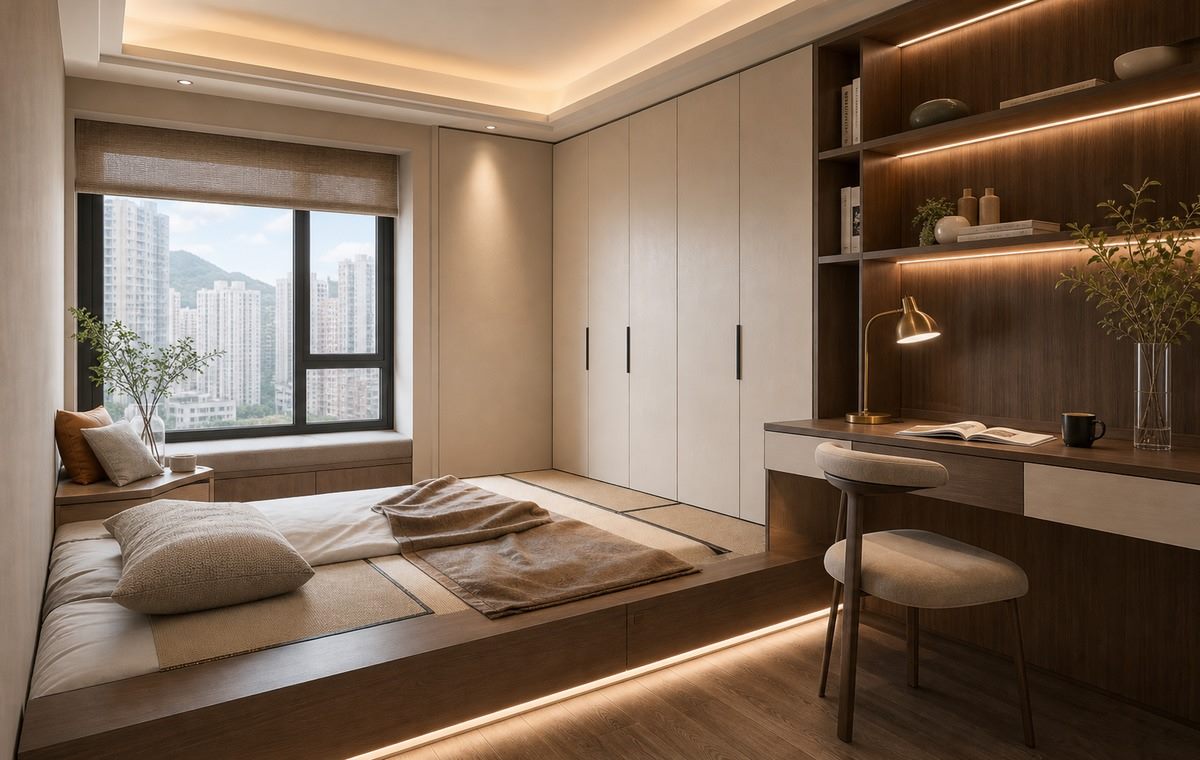
Built-in vs freestanding: the eight numbers that decide it
| Dimension | Built-in (fitted) | Freestanding |
|---|---|---|
| Typical cost, per unit | HK$15,000–40,000 | HK$2,000–10,000 (2–4 doors) |
| Height used | Full 2,400–2,600mm to the ceiling | About 2,010mm, leaving a 590mm ledge |
| Width used | Wall to wall, scribed | Standard modules only; 100–400mm often left over |
| Internal depth | 550–600mm clear for hanging | 550–580mm, fixed by the maker |
| Storage in a 2,400mm alcove | About 3.3 m³ usable | About 2.2 m³ usable |
| Beams, columns, slopes | Built around them | Gaps and infill panels |
| Lead time | 3–5 weeks from survey | 1–7 days in stock; 2–6 weeks special order |
| Warranty | 3–5 years body, 3–10 years hardware | 1–5 years, wear parts often excluded |
| Moving house | Fixed; dismantling usually destroys it | Moves with you |
Typical range, subject to site survey. Price bands follow the 2026 Hong Kong whole-home pricing guide; the actual quote follows the measured plan.
What a wardrobe costs in Hong Kong in 2026
Bedroom wardrobes are the second-largest line in a Hong Kong custom furniture budget after the kitchen. The numbers below are market references for preliminary budgeting, not quotations — a 4–6 running-foot wardrobe, which is the usual size in a Hong Kong second bedroom, is exactly what produces the HK$15,000–40,000 band.
| Item | Market reference (HK$) | What moves the price |
|---|---|---|
| Fitted wardrobe, full-height, per unit | 15,000 – 40,000 | Width, sliding or hinged doors, glass, internal fittings |
| Fitted wardrobe, walk-in or L-shaped | 45,000 – 90,000 | Two or three runs, island, lighting |
| Freestanding modular wardrobe, 2–4 doors | 2,000 – 10,000 | Brand, door finish, whether internals are included |
| Freestanding plus fitted internals | 4,000 – 14,000 | Drawer boxes, pull-out trays, rails bought as extras |
| Whole home, two-bedroom flat | 150,000 – 350,000 | Number of spaces, board grade, hardware brands |
Typical range, subject to site survey. Delivery, assembly and old-furniture removal are separate lines on most Hong Kong quotes and should be confirmed in writing.
The alcove calculation that usually settles it
Take the common Hong Kong case: a bedroom alcove 2,400mm wide and 600mm deep under a 2,600mm ceiling.
- Built-in: 2.4 × 0.6 × 2.6 = 3.74 m³ gross. Panels and the back take roughly 12%, so about 3.3 m³ of usable volume. At a mid-range HK$24,000, that is about HK$7,300 per m³.
- Freestanding: two 1,000mm modules side by side use 2,000mm of the 2,400mm wall, at 580mm deep and 2,010mm high = 2.33 m³ gross, or about 2.2 m³ usable. At HK$6,500 for the pair, that is about HK$2,950 per m³.
So the built-in gives you roughly 1.1 m³ more storage — about 50% more — at about 2.5× the cost per cubic metre. That is the whole argument in two numbers, and it points in different directions depending on your constraint. If floor area is the scarce thing, as it is in most Hong Kong flats, the extra 1.1 m³ is storage you cannot buy any other way. If cash is the scarce thing, freestanding wins comfortably and you accept the ledge.
Humidity: where a cheap wardrobe fails in Hong Kong
Hong Kong's spring humidity is the reason a wardrobe decision is also a board decision. Three details separate a unit that survives ten summers from one that swells at the bottom edge:
- Board grade. Formaldehyde emission classes run E1 (≤0.124 mg/m³), E0 (≤0.05 mg/m³) and ENF (≤0.025 mg/m³) under GB/T 39600-2021. E1 is the baseline to insist on; E0 is what most Hong Kong bedrooms should be specified at, because a bedroom is a small, closed, air-conditioned box.
- Panel thickness and back. An 18mm carcass holds hinges and runners without creep; a 9mm back panel closes the unit. A thin 5mm back stapled on is where mould starts, because condensation forms on the cold panel behind the clothes.
- Sealed edges. Cut edges are the entry point for moisture. Every visible and hidden edge should be banded — 1mm PVC or ABS, or laser edge on a lacquered door — with no raw board at the bottom rail or around service cut-outs.
For a fitted unit against an external wall, add a vapour barrier and leave a 20–30mm gap at the top for air movement. FameHouse specifies boards, edge banding and hardware by line on the quotation, so the grade you paid for is the grade that arrives — and boards are quoted at E1 as standard with E0 available.
When freestanding is the better buy
- The tenancy is under three years. A fitted wardrobe is a capital cost that stays with the flat; you cannot take 3.3 m³ of cabinetry to a new lease.
- You may reconfigure the room. A nursery today, a study in four years — fixed cabinetry makes that change expensive.
- The budget ceiling is real. Under HK$10,000 total, a freestanding run plus a couple of drawer inserts is the honest answer, not a stripped-down fitted unit with thin panels.
- The wall is genuinely standard. A 2,000mm clear wall with no beam, no column and no skirting conflict is the one case where a modular run fits almost as well as a fitted one.
When built-in pays for itself
- The wall is an alcove. Two side walls and a ceiling give a fitted unit three surfaces to close against; a freestanding box gives you two dust gaps and a ledge.
- A beam or column cuts the ceiling. Hong Kong bedrooms routinely lose 200–400mm to a structural beam over the wardrobe wall. Fitted cabinetry is scribed around it; a standard box either stops short or stands proud of the wall.
- You need the height. Two stacked rails — long hang at 1,400–1,700mm clear, short hang at 900–1,100mm — only work floor to ceiling. That is where the 590mm comes back.
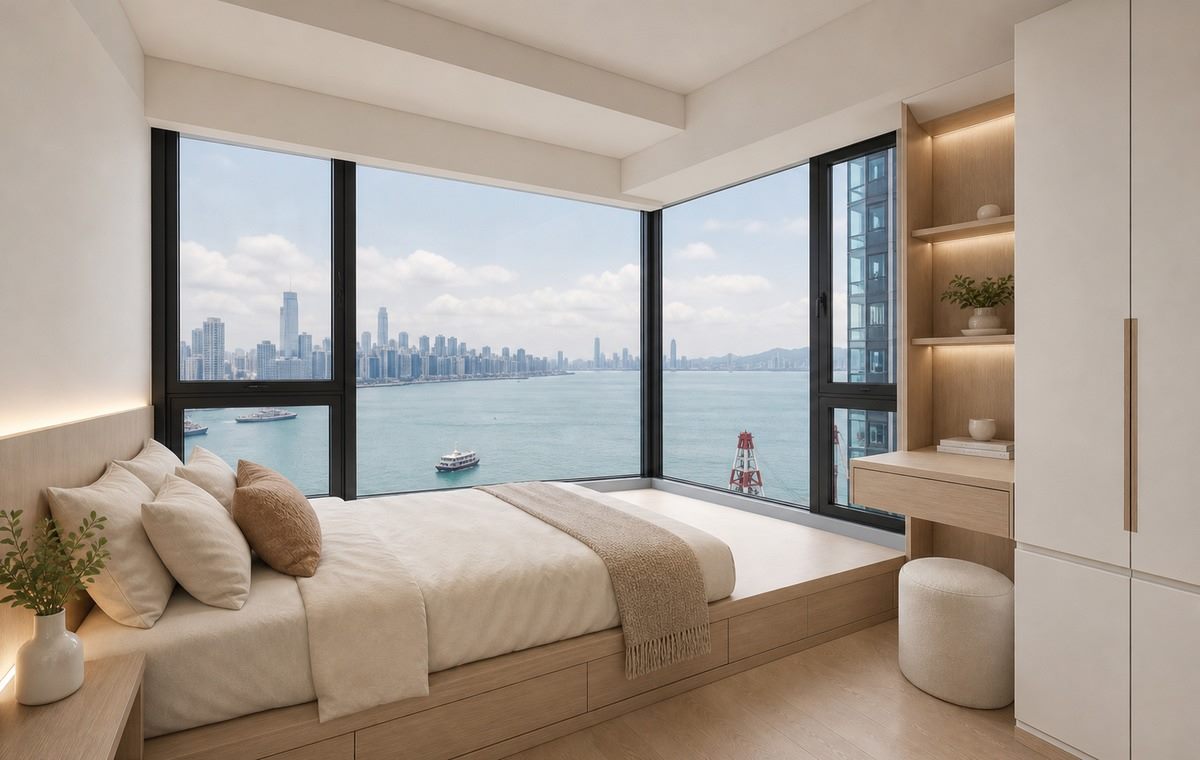
- The wardrobe has to do a second job. Wardrobe plus desk, wardrobe plus window-seat storage, wardrobe plus headboard: these are one measured composition, not two purchases.
- You are staying. Over a ten-year horizon the 3–5 year structural warranty and the repairable hardware matter more than the entry price.
Lead time and what installation day looks like
| Stage | Built-in wardrobe | Freestanding wardrobe |
|---|---|---|
| Free site measurement | 1 visit, 60–90 minutes | Not required; you measure the wall |
| Drawing and sign-off | 3–7 working days | None |
| Production | 3–4 weeks | In stock, or 2–6 weeks for a special order |
| On site | 1–2 days, plus lift booking | 2–4 hours to assemble |
| Total | 3–5 weeks | 1–7 days |
Typical range, subject to site survey. Sliding doors with imported tracks, glass fronts or lacquer add about a week; full lead-time planning is covered in the lead-time guide.
On a fitted job the sequence matters more than the speed. Flooring goes down and walls are painted first, because a wardrobe fixed to the wall cannot be painted behind and will not sit level on a bare slab. The crew sets and levels the carcasses, cuts service gaps for sockets, hangs doors and adjusts hinges and runners, then walks the punch list with you before handover.
For interior designers and B2B buyers
On trade projects the wardrobe is rarely the problem — the interface is. Two things protect a programme: releasing production drawings zone by zone instead of waiting for the whole flat, and booking the factory slot before the client's finish selection is locked. Specify the carcass at 18mm, the back at 9mm, the formaldehyde class, the hinge and runner brands and the edge-banding type on the drawing, because that list is what a factory can actually hold you to. FameHouse works from shop drawings and phased delivery schedules with designers and contractors, backed by our own smart factory in Zhejiang; as a long-term supplier to global building-material brands, production and QC follow the documentation standards those brands audit. FAME was founded in 2009, and the same 17+ years of export production now runs through our Hong Kong service team.
How to specify either option without regret
- Measure the opening, not the room. Wall-to-wall clear width at three heights, ceiling height under the beam, skirting depth and the swing of the door.
- Decide the hanging mix before the layout. Count long garments (coats, dresses) and short ones separately; the ratio sets the rail heights and how much shelving you need.
- Put the money in the moving parts. Hinges and runners are what fail first; a mid-grade board with good hardware outlasts a premium board with cheap runners.
- Get the internals itemised. Drawer boxes, pull-out trays, LED and glass are add-ons on most quotes and are where budgets drift.
- Confirm the warranty in writing. Body, hardware and electrical are three different periods with three different exclusions.
FameHouse starts every wardrobe with a free site measurement and free design, so the price you compare is built on your actual opening rather than a floor plan. To book a visit in Hong Kong, message WhatsApp +852 6159 8571.
FAQ
Is a built-in wardrobe better than a freestanding wardrobe in Hong Kong?
Built-in is better when storage volume is the constraint: in a 2,400mm alcove it gives about 3.3 m³ against 2.2 m³ for two freestanding modules. Freestanding is better in a short tenancy, under a HK$10,000 budget, or where the next tenant may want the wall back.
How much does a built-in wardrobe cost in Hong Kong?
Roughly HK$15,000–40,000 per full-height unit, depending on width, door type, internals and board grade. A whole-home package for a two-bedroom flat is typically HK$150,000–350,000. The real figure follows the free measurement and the itemised quote.
How deep should a fitted wardrobe be?
550–600mm of internal clear depth for front-facing hanging, because a jacket on a hanger needs about 500–550mm. A shelving-only unit can work at 400mm; below that the rail has to run sideways.
Can I put a freestanding wardrobe into an alcove?
Only if the alcove matches a standard module. Units come in 500mm, 750mm and 1,000mm widths, so a 2,380mm alcove leaves 380mm of dead wall, and doors need 600mm of swing in front.
Do built-in wardrobes cause damp or mould in Hong Kong?
Not when built correctly. Damp comes from an unsealed back panel on an external wall, raw cut edges, and clothes pressed against a cold wall in spring. Specify an 18mm carcass, banded edges, a vapour barrier and a 20–30mm gap at the top.
How long does a fitted wardrobe take from measuring to installation?
3–5 weeks in total: 3–7 working days for the drawing, 3–4 weeks in production and 1–2 days on site. Sliding doors with imported tracks, glass or lacquer add about a week.
What warranty should a fitted wardrobe come with?
Market practice is 3–5 years on the body and structure, 3–10 years on hinges and runners by hardware brand, and 1–2 years on electrical parts such as LED. Get the periods, scope and response time in writing.
Does a built-in wardrobe add value to a Hong Kong flat?
It adds perceived value — buyers read storage as usable floor area — but resale value is not guaranteed. A fitted layout is personal: if the next owner wants a desk there, the unit is a demolition cost.